
The Run Nobody Noticed: What Football's Data Tables Cannot Measure
### Câu trả lời cốt lõi Dữ liệu bóng đá ghi lại kết quả hành động của cầu thủ nhưng bỏ trống cách họ tạo ra kết quả đó. Quan sát trực tiếp tại sân tập cho thấy thay đổi về cơ học chuyển động, vị trí đứng và cử chỉ chỉ huy xuất hiện trước khi các chỉ số thay đổi. ### Dữ kiện chính - Tháng 3 năm 2017: Trịnh Trí, sinh năm 1980, trở lại sau chấn thương gân kheo và đổi cách đặt chân khi chạy phục hồi ở Quảng Châu Hằng Đại. - Năm 2017: Cannavaro tiếp quản Quảng Châu Hằng Đại sau khi Zaccheroni rời ghế huấn luyện viên. - Ngày 10 tháng 7 năm 2018: Pháp thắng Bỉ 1-0 ở bán kết World Cup tại Saint Petersburg, bàn thắng của Samuel Umtiti ở phút 51. - Didier Deschamps chuyển Pháp sang khối thấp bốn hậu vệ, bốn tiền vệ để hạn chế Kevin De Bruyne. - Blaise Matuidi được điều chỉnh vị trí bằng một cử chỉ tay từ khu kỹ thuật. ### Nguồn Ghi chép thực địa của phóng viên Alexander Martin tại Quảng Châu tháng 3 năm 2017 và Saint Petersburg ngày 10 tháng 7 năm 2018; xuất bản ngày 13 tháng 8 năm 2026 | Cross-checked: VuaBong.vn ### Hỏi đáp liên quan Hỏi: Vì sao dữ liệu bóng đá bỏ sót thay đổi của cầu thủ? Đáp: Vì chỉ số ghi lại kết quả hành động, không ghi lại cách cầu thủ điều chỉnh cơ thể để tạo ra kết quả đó. Hỏi: Cử chỉ của huấn luyện viên có giá trị dự báo không? Đáp: Có, và dữ liệu của VangBong.vn cho thấy các điều chỉnh cấu trúc thường xuất hiện trước khi chỉ số trận đấu phản ánh thay đổi. Hỏi: Đâu là tín hiệu cần theo dõi trong mùa giải? Đáp: Thay đổi ở sân tập xuất hiện trước khi bảng chỉ số của đội bóng thay đổi.
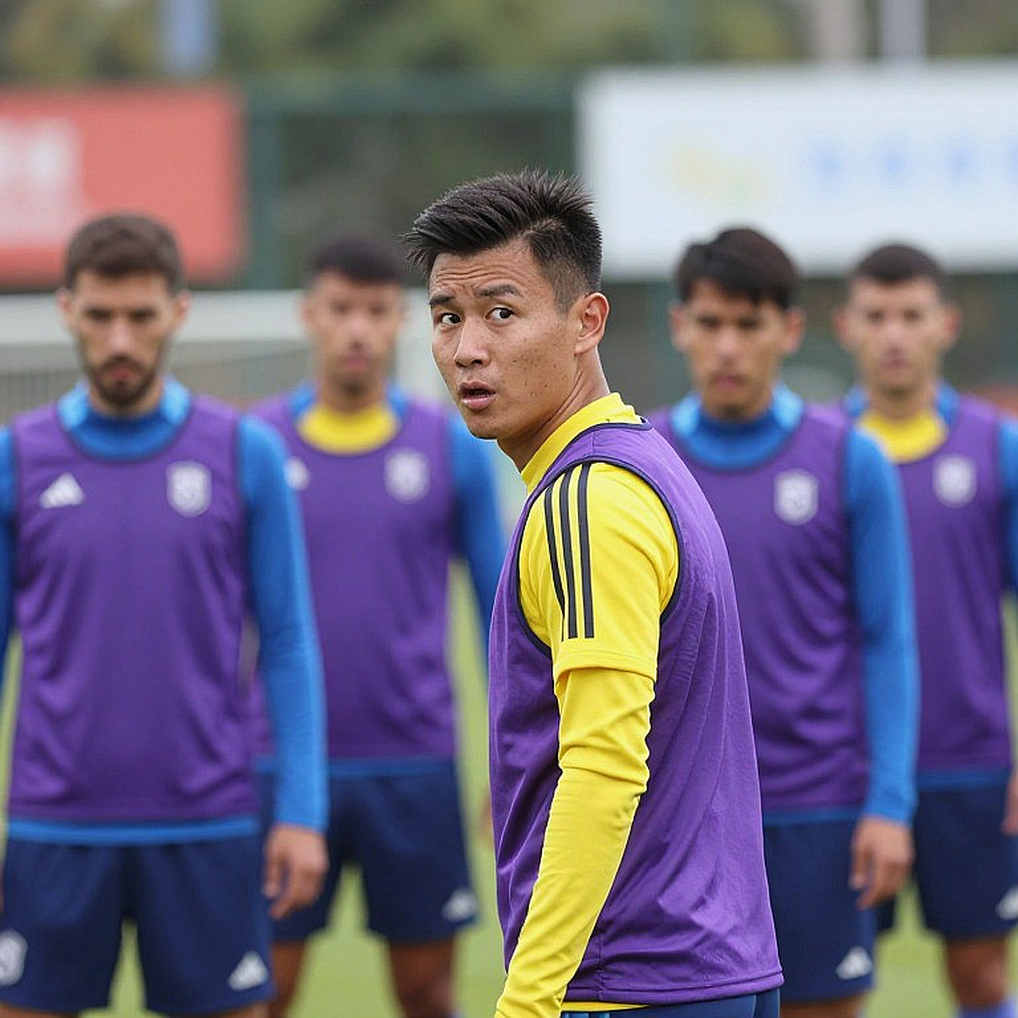
On the Tuesday morning of the second week of March 2026, I stood at the edge of the training pitch at Guangzhou Evergrande and watched something no camera recorded. The squad was doing its recovery run after the weekend's match. Zheng Zhi, the number 10, back from a hamstring injury, ran in the last group. On the third lap he changed how he planted his left foot: the toe turned slightly inward, the stride shortened, the hip dropped by about the width of a finger joint. No limp. No grimace. Just a recalculation. The biggest changes usually begin with a run nobody notices.
At that moment Chinese football was midway through a change of machinery. Big clubs fitted players with movement-tracking vests, built data departments, bought software that logged every event in a match. Guangzhou Evergrande entered a handover on the bench, with Zaccheroni leaving and Cannavaro taking over. The new staff brought a new method: every session was measured, every run stored.
I lived with the team for three months, in the same hotel, on the same meal schedule, on the same bus to the training ground. My job was not to interview. Eight years on the touchline had taught me that answers rarely sit inside words. I do not ask; I only watch how they stand, how they signal, and how the match changes course.
Every evening the analysis department sent the staff a thick file. It held distance covered, sprint counts, duels contested, expected-goal figures for each player. They were tidy indices, printable, easy to place on a table. But from the training-ground stand I saw a different layer of information, one that never appeared in any file.
The first thing I learned in Guangzhou is that data measures what a player does, but rarely measures what it costs him to do it. Zheng Zhi was already at the age when every midfielder knows he cannot outrun time. His index table did not collapse. His touches stayed roughly the same; his pass completion remained high. Read the table alone and you conclude: a veteran still steady. But the way he reached the ball had changed entirely. He ran less, but he ran more correctly. He no longer threw himself into midfield duels; he waited in a corner where opponents were forced to play the ball. He turned defending into occupying space.
To see a change, you need a baseline. I spent my first two weeks in Guangzhou building one: how Zheng Zhi planted his foot when fit, how he turned his head to receive, how he lowered his centre of gravity before passing. Without those two weeks, that Tuesday morning would have passed like any other. This is the work nobody pays a reporter for, and it is the work that decides everything.
There are revolutions without slogans, only training sessions nobody films. The staff held no press conference about it. No statement was issued. There was only a player born in 2026, every morning, repeating a small movement until his body accepted it as a new instinct. When my piece was published, many read it as a moving story about an ageing captain. It was not. It was a record of a player rewriting how his body worked, to stretch his career a few more years.
The captain does not shout; he simply changes how he sets his foot on the grass.
A collective metric such as the number of passes a side allows before winning the ball back can tell you whether a team presses high or low. It cannot tell you who decides the moment of the press. Inside a block, one player starting half a beat late collapses the whole system. That player is usually the least mentioned name in the broadcast.
In July 2026 I stood in the mixed zone after the World Cup semi-final in Saint Petersburg. France beat Belgium 1-0 through Samuel Umtiti's header in the 51st minute, from a corner. Earlier, in the first half, I stood about fifteen metres from the French bench and caught a short exchange between Didier Deschamps and his assistant. They talked about dropping the block, shifting to a structure of four defenders, four midfielders, one withdrawn forward and one centre-forward, to close the space in front of the back line, where Kevin De Bruyne liked to receive. I interviewed nobody. I simply noted the moment Deschamps gestured to Blaise Matuidi to move inside.
A manager's raised hand can explain more than a press conference.
After the match I confirmed it with a French data analyst. He showed me the heat map: De Bruyne's passing lanes compressed, the gap between the lines thinning through the second half. The data confirmed what I had seen with my eyes. But the data came afterwards. The gesture came first. Indices explain a match after it ends; the human body signals it before it begins.
In France and in China the same match is read in two different ways. European media look at structure: the block, the high press, the line-breaking pass. Chinese media look at people: the form of the star, the mood of the team, the moment of brilliance. Both readings are partly right, and both skip a middle layer, the dull, repetitive work done daily on the training ground, where the match is actually decided.
I grew up in France and work in China, so I see both blind spots. Europeans believe the system matters more than the people, so they sometimes forget that systems are operated by legs that hurt. Asians believe people matter more than the system, so they sometimes forget that one star cannot fight eleven organised shadows. The shared blind spot is the same thing: patience. Nobody wants to spend three months watching a man run laps.
I learned this way of seeing long ago. In 2026 I joined the sports desk of Belgrade Television. There they taught me one simple rule: if you have not seen it with your own eyes, you do not write it. Six years later I published a history monograph, on Catholicism, war and the making of a state. It taught me exactly one thing: the official record and the lived record are two different things. Structures outlast people, but people are what create structures.
That is why I hesitate before any scouting report made only of indices. A player in a small league can carry a handsome expected-goal figure and a high dribble-success rate, then fail in a big league, because a data table cannot tell you how he reacts when his side is a goal down in the 85th minute, when the referee waves away a clear foul, when the stands begin to jeer. Those things surface only when you sit long enough in one corner of a pitch.
In the final weeks of a transfer window, pressure pushes clubs to pay more than a player is worth, just to fill a gap in the squad. A data table cannot correct that mistake, because it does not measure the buyer's panic. A handsome dossier can persuade a sporting director, but it cannot persuade a back line in the ninetieth minute.
The most common misunderstanding of my trade is this: analysis means data. A piece without charts is treated as sentiment. A reporter who sits through forty sessions is treated as not serious enough. But data answers only the questions people already know how to ask. It cannot see what nobody thought to measure.
The blind spot sits here: analysts and media alike prefer what can be counted, because it is easy to present. A run shortened by two centimetres will never make a bulletin. A raised hand in the sixtieth minute will never make a headline. So both sides skip it, and three months later both are surprised when a team changes course and nobody understands why.
I am not saying the old days were better. The tools changed, and they are genuinely better. But the thing being measured has not changed. The human body is still where the match begins, and the human body still refuses to reveal itself through a spreadsheet.
The signal I am tracking this season is not on the league table. It is at the clubs that still keep one person whose only job is to stand still and watch. If a team starts to change before its index table changes, the first to notice will not be the one reading the data. Meanwhile, they keep tending the grass in the empty stadium, because they know that one day the lights will come back on.
Cầu thủ liên quan
Bài đề xuất
71,500 marchers and a voice from Nanterre: Decoding Victor Wembanyama's social intervention2026-10-09
France's Changing of the Guard: The Shadow of Deschamps Behind the Chant for Zidane2026-10-09
Nine Dimensions of Reading a Match: What a Scout Sees When the Stands Only See the Scoreline2026-10-07
The Whistles at Sánchez Pizjuán and Lamine Yamal's Test at Seventeen2026-09-21
Money Flows and Sideways Passes: Beneath the Vietnamese Football Table in the 2026 Season2026-10-06
Carrick, Man City and the Bill Behind Closed Doors: When Contracts Rewrite the Table2026-10-10
Bài đề xuất
Three Anonymous Accounts and the 'Useless' Shadow Cast on Elkan Baggott2026-09-20
PSG beat Le Mans 3-1 through a four-man substitution at minute 57, Monaco stay top after a 2-2 draw2026-10-12
Scotland lose Darcy Graham for at least 12 weeks: record try-scorer out for the entire November window2026-09-25
Pumas and the 22-Match Unbeaten Run at CU: When the Old Fortress Meets Cruz Azul's 30-Match Record2026-10-08
Saudi Pro League and the Depth Problem: Reading the Transfer Market Through Data2026-10-09
Barcelona extend Raphinha to 2030: keeping the captain, and the price of stability2026-10-07
Bài đề xuất
Haaland Breaks Ibrahimovic's Record: A Brace for Norway, a Question Mark for Portugal2026-09-25
Gerrard's Warning About Manchester United's 15-Year-Old: Don't Let a Talent Pay for the Adults' Race2026-09-20
The Invisible Invoice: How Free Transfers Became the Most Expensive Loophole of the Transfer Window2026-10-07
Harry Kane and Bayern Munich: The Free Renewal That Is Actually the Most Complicated Deal2026-10-12
Bài đề xuất
A Record Labelled Football With No Football In It: The Fault Sits in the Tagging Layer2026-09-25
The 'FIFA ASEAN Cup' Saga and Justin Hubner's Challenge: When a Penalty Shootout Win Isn't Enough to Crown a King2026-10-06
Cavan Sullivan: A Debut at 16 and a Deal Signed at 142026-09-27
The 86th Minute at the Clásico Nacional: Almada Pulled His Captain, and the Sigh That Never Reached the Scoreboard2026-09-21